
Diesel Motorhome Service and Repair in Chino, CA
A diesel pusher is two machines sharing one frame: a heavy-duty truck chassis at the bottom and a house on top of it. Most shops are set up for one or the other. McBride's services both under one roof at our shop in Chino, which means the chassis service, the air brakes, the transmission, the generator, the hydronic heat and the body all get looked at by people who talk to each other. Family-owned in Chino since 1967. Here is how we approach a diesel coach and what we see on them.

What makes a diesel pusher different to service?
Almost everything below the floor. A gas Class A rides on a Ford F-53 with hydraulic brakes and a front engine. A pusher puts the diesel in the back, runs the brakes and the ride height on compressed air, and usually sits on a Freightliner or Spartan chassis. That changes the service in four practical ways.
The air system is part of the brakes, the suspension and often the steps and the seats. One compressor feeds it all, and moisture is its enemy. The cooling stack lives at the rear, behind the engine, where it collects road grime that a front radiator would never see. The emissions hardware on newer coaches, the particulate filter and the diesel exhaust fluid system, has its own warning lights and its own ways of failing. And the coach is heavy, so tires, brakes and the transmission all work harder on every grade.
None of that is exotic. It is simply a different checklist, and a diesel coach that is serviced off a gas coach checklist will eventually tell you about it.
What do you do in a diesel pusher service?

We run two packages on diesel coaches, laid out in full on our RV chassis service page.
Minor service.
Engine oil and filter, chassis lubrication, an inspection of belts, hoses and rubber, a top-off of chassis fluids, and a systems inspection. Recommended every six months for coaches driven more than 12,000 miles a year.
Major service.
Everything in the minor, plus the fuel filters, the air filter, the crankcase filter where the engine has one, a radiator cap pressure test, front wheel bearing gear oil where equipped, a visual brake inspection and a full systems evaluation. Recommended once a year for coaches driven less than 12,000 miles a year, which describes most of the pushers we see.
Most owners in this area fall into the second group. The coach lives in a storage lot in Chino or Ontario for months, comes out for a trip to the river or the mountains, and goes back. Low miles do not mean low wear on a diesel. Fuel ages, seals dry out, and the air system collects water whether the coach moves or not. That is why the annual major service exists.
Why is my air pressure slow to build, or why does it leak down overnight?
Those are the two air-system complaints we hear most on pushers, and they usually point to different things.
Slow to build points at the supply side:
The compressor, the governor that tells it when to stop, or an air dryer that has stopped doing its job. The dryer pulls water out of the air before it reaches the tanks. Its filter cartridge is a service item, and on a coach that sits, a tired dryer lets moisture through to the tanks, the valves and the brake chambers.
Leaking down overnight points at the system downstream:
A fitting, a line, a valve, an airbag in the suspension or a brake chamber. Finding it is patient work with the coach aired up and quiet, and it is not something to guess at with a spray bottle in a storage lot.
Either way, the air system is the brakes. The detail on air and hydraulic brake service, including how often the air dryer filter should be replaced, is on our RV brake repair page, and the differences between the two systems are explained in our air vs hydraulic brakes guide.
My pusher runs hot climbing the Cajon Pass. What should I check?
Start at the back of the coach. A pusher's radiator and charge air cooler sit at the rear, stacked together, and they breathe whatever the coach drags behind it: road film, dust, bugs and oil mist from the engine compartment. The fins load up from the inside face as well as the outside, so a radiator can look clean from the grille and still be half blocked.
The Inland Empire makes this worse than most places. Summer days over 100 degrees, plus the long pulls out of the basin on the 15 over the Cajon Pass, the 10 through Banning and the 5 over the Grapevine, are exactly when a marginal cooling system runs out of margin. The usual causes, roughly in the order we find them, are a loaded radiator or charge air cooler core, a tired fan clutch or fan drive, coolant that is past its service life, and boots or clamps on the charge air side that leak boost under load.
What we do: pressure test the cooling system, test the cap, inspect the cores from both faces, check the fan drive, and look at the charge air plumbing. If the engine itself is setting codes, that becomes an engine diagnosis, which is covered on our RV engine service and repair page.
The emissions light is on and the coach went into reduced power. Now what?
On newer diesel coaches, a warning tied to the particulate filter or the diesel exhaust fluid system can put the engine into reduced power until the fault is cleared. It feels dramatic, and it is designed to. The reasons range from the simple, such as low or contaminated fluid, a failed sensor or a coach that never runs long enough to clean its own filter, to repairs that need parts.
Coaches that make short trips are the ones we see most with filter complaints. A diesel cleans its particulate filter by running hot for a sustained period, and a coach that moves from the storage lot to a campground thirty minutes away, twice a year, rarely gets there.
We read the codes, find out which part of the system set them, and tell you what it is before anything is replaced. If you are stuck on the road in reduced power, call before you clear codes or keep driving, because the order of steps matters on these systems.

Do you service Allison transmissions in diesel pushers?
Yes. Most pushers use an Allison automatic, and the service on them is different from the Ford automatic behind a gas coach: an external filter change, a complete fluid exchange, diagnostics and a performance check. If the coach has a transmission retarder, that gets checked as part of the same visit. The full breakdown, including how often we recommend fluid service on a pusher, is on our RV transmission service page.
What about the generator and the hydronic heat on a diesel coach?
Both run on the same diesel as the engine, and both suffer from the same thing: sitting. A diesel generator that never carries a real load builds carbon and fuel residue, and a hydronic heating system that runs once a winter has its burner, its fuel nozzle and its coolant loop to worry about. Both are serviced here. See RV generator service for the generator side, including why we test generators under load, and Aqua-Hot system service for the hydronic side.
Can you handle the body and paint on a 40-foot diesel coach?

Yes, and this is the reason many pusher owners find us in the first place. Full body paint is common at this level, and finishing a coach that long properly needs a booth long enough to lay it down in one pass. Ours is 40 feet and fully enclosed. Collision, fiberglass, slide rooms and full repaints are all done in the same building as the chassis work. See RV paint and body repair and RV slide-out repair.
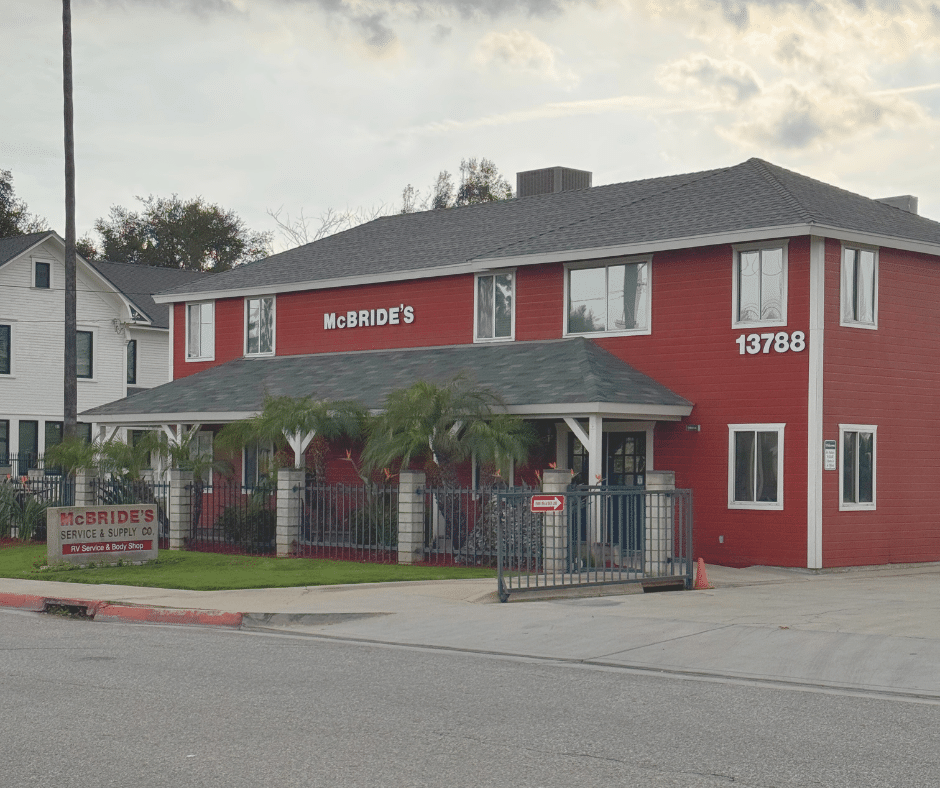
No. McBride's is an in-shop facility at 13788 Oaks Ave in Chino. We do not send technicians to driveways or storage lots. On a pusher that is a practical point, not a policy line: air leaks need a quiet shop to find, cooling problems need the coach on the floor with the engine door open, and brake work needs the coach supported properly.
If the coach cannot be driven, we can refer a transport company: Tow Solutions, LLC, (909) 730-4815. Contact the shop before any coach is transported, so we know it is coming and can plan for it.
Frequently asked questions about diesel motorhome service
Which diesel coaches do you work on?
Diesel pushers from the builders that dominate this market, including Newmar, Tiffin, Fleetwood, Holiday Rambler, Winnebago, Thor Motor Coach and others, on Freightliner and Spartan chassis. Our RV brands we service page explains how coach type changes the work.
Is a diesel pusher service much more involved than a gas coach?
Somewhat. There are more filters, an air system to inspect and a cooling stack to look at, and the coach takes more room on the floor. The packages are built for that, so you know what is included before the coach comes in.
How do your estimates work?
We inspect first and quote second. Estimates include a budgeted amount for parts, and the final price adjusts to the parts actually used.
Do you do emissions testing?
No. McBride's does not do emissions or smog testing of any kind. We diagnose and repair the emissions hardware on the coach itself.
Can you work on my coach if it was serviced somewhere else?
Yes, and most of the pushers we see were. Bring whatever records you have. If there are none, we establish a baseline before we recommend anything.
Where are you, and when?
13788 Oaks Ave, Chino, CA 91710, Monday through Friday, 8 AM to 4 PM. We sit near where the 60 meets the 71, a reasonable drive from most of the Inland Empire and North Orange County.
Hear From Our Satisfied Customers





They are always professional, courteous and they have resolved any and every issue I had.





Bring the coach in and we will walk it with you before anything is quoted. McBride's RV has been family-owned in Chino since 1967. Call (909) 627-7566 to book a diesel service.
McBride's RV Service & Paint, BAR ARD 314817, 13788 Oaks Ave, Chino, CA 91710, (909) 627-7566.