
RV Appliance Installation and Upgrades
Replacing an appliance in an RV is not the same job as replacing one in a house. The opening is a structural cutout, the power is a mix of 12 volt, 120 volt and propane, the venting is part of the roof or the sidewall, and the coach was built around the original unit rather than the other way round. We install refrigerators, roof air conditioners, water heaters, cooktops, ovens, microwaves, converters and inverters at our shop in Chino, and we measure and check the fit before anything gets ordered, because the expensive mistake in this work is buying the wrong unit rather than fitting it badly.
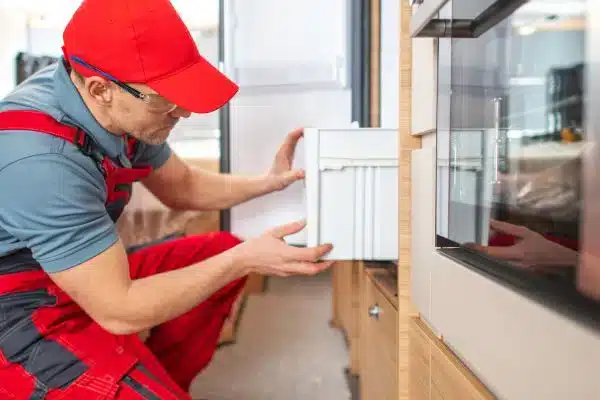
What RV appliances do you install?
Refrigerators, absorption and 12 volt compressor. Roof and basement air conditioners. Water heaters, tank and tankless. Cooktops, ranges, ovens and microwave and convection combinations. Range hoods and vent fans. Toilets and water system components. Converters, inverters, transfer switches and battery banks, which are usually the real limit on what else you can add.
We also do the work that surrounds the appliance and is easy to underestimate: cabinet modification, new gas line runs and pressure testing, sidewall and roof vent work, resealing every penetration we open, and the 12 volt and 120 volt circuits behind the unit.
Will a new appliance actually fit my RV?

That is the first thing we check and the reason we would rather see the coach than take an order over the phone. Three things have to line up.
The opening.
RV appliance cutouts are not standard sizes. Manufacturers changed dimensions between model years, and a coach that had a Dometic unit does not automatically take the current Dometic equivalent. We measure the cutout height, width and depth, and the door swing and the aisle clearance, before we spec a replacement. Cabinet modification is often possible. It is much better as a decision made in advance than as a surprise on install day.
The power and the fuel.
An absorption refrigerator runs on propane and 120 volt. A 12 volt compressor refrigerator runs on the battery bank, which means the bank, the charge source and the converter all have to be up to it, and it keeps drawing while the coach is parked. Anything that runs through an inverter needs that inverter sized for startup surge, not just for running load, which is where most nuisance tripping comes from. Adding a second roof air conditioner means asking what the generator and the shore cord can actually carry. On a lot of coaches the appliance is the easy part and the electrical system is the project.
The venting and the roof.
An absorption unit needs its lower vent and roof vent, and it needs the chimney path clear, or it will underperform in exactly the heat we get here and you will think the new unit is defective. A roof air conditioner sits on a 14 by 14 inch opening with a gasket that has to compress evenly, and the ceiling assembly has to be sound enough to take the clamp load. A tankless water heater has different combustion air and exhaust requirements than the tank unit it replaces.
Should I replace my absorption refrigerator with a 12 volt compressor unit?
It is the most common upgrade question we get, and the honest answer is that it depends on how you camp.
An absorption refrigerator has no compressor, runs silently, and will hold on propane for a long weekend without touching the batteries. It is also slower to recover after the door has been open, it is sensitive to being out of level, and it works hardest exactly when the Inland Empire is at 105 degrees and the RV is sitting in the sun.
A 12 volt compressor unit cools faster, holds temperature better in heat, does not care about level, and removes a propane appliance and its flue from the coach. It also runs off your batteries continuously, so it moves the problem to the electrical system. If the coach has a single group 27 lead acid battery and no solar, a compressor fridge will change how you camp, and not in the direction you wanted.
We would rather have that conversation with the coach in front of us, look at what is actually in the battery bay, and tell you what the conversion really involves. Sometimes the right answer is the compressor unit plus a battery and charging upgrade, quoted as one job. Sometimes the right answer is a new absorption unit and a cleaned-out vent stack.
Should I go up a size on my roof air conditioner?
Only if the coach can carry it, and that is a power question before it is a comfort question.
Going from a 13,500 BTU unit to a 15,000 BTU unit is a real improvement in Inland Empire heat, and it is the most common upgrade we get asked about after refrigerators. What decides whether it is a good idea is what else is running. A 15,000 BTU unit draws more starting current, and on a coach with two air conditioners, a generator sized for the original pair, and a 30 amp shore cord, the upgrade can leave you unable to run both at once on a hot afternoon, which is precisely when you wanted them.
The other two things we check are the roof opening and the ceiling assembly, because the standard 14 by 14 inch opening is common but the ceiling structure that has to take the clamp load is not, and whether the coach is ducted or non-ducted, because the two use different plenum and control setups and they are not interchangeable without work.
If the answer is that the coach will not carry the bigger unit, we will tell you that rather than fit it and let you find out in August.

How does an appliance installation work at your shop?
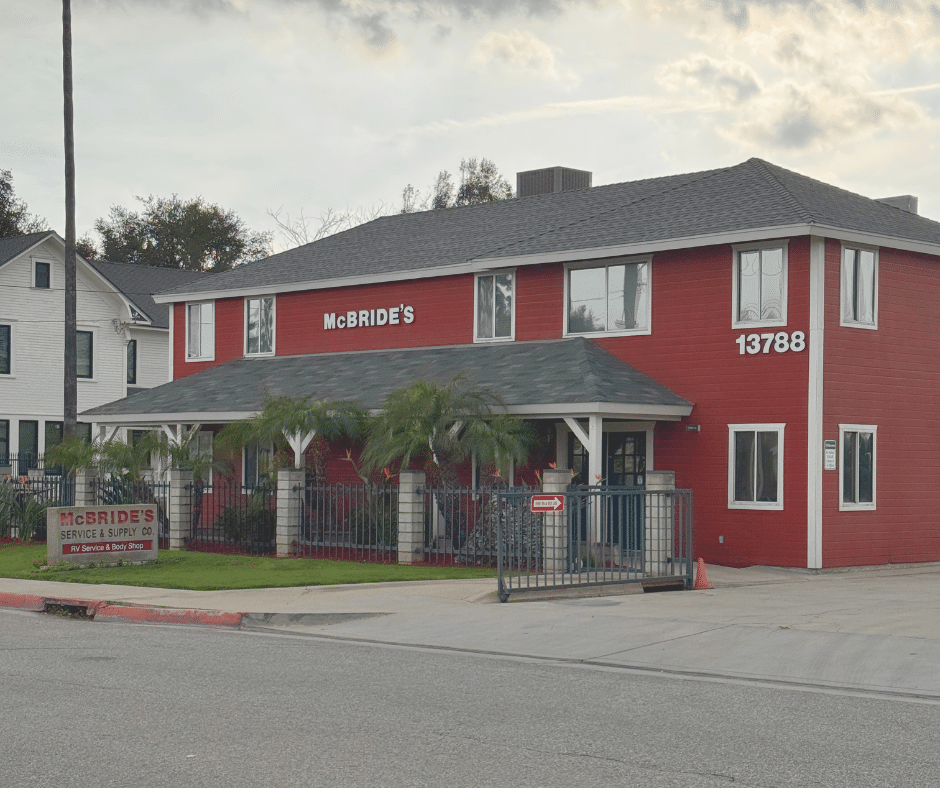
You bring the coach to 13788 Oaks Ave in Chino and we look at the actual installation, not a model number. We measure the opening, inspect the venting, look at the gas line and the circuit that feeds it, and check the condition of what is around the unit, because water damage behind a refrigerator or under a water heater is common and it changes the job.
Then you get an estimate that reflects what we found. Estimates include a budget for parts, and the final price adjusts to the parts actually used, so if we open the wall and find the vent chase needs rebuilding you will hear about it before we do it, not after.
Once the unit is in, we test it the way you will use it. An absorption refrigerator gets run on both propane and 120 volt and checked for cooling at the fins, not just at the control panel. A gas appliance gets a pressure test on the line we worked on. A roof air conditioner gets checked for supply and return temperature split and for a dry seal at the gasket. An inverter install gets load tested.
What does an RV appliance installation cost?
Honest answer: the appliance price is the part you can look up, and it is usually not what decides the total. What decides the total is whether the opening needs modifying, whether the electrical or gas supply needs work, and whether there is damage behind the old unit. A straight like-for-like swap into a sound opening is a very different job from one that also needs cabinet work, a new gas line run, or an inverter and battery upgrade behind it.
We quote after we have looked at the coach. Every estimate includes a budget for parts, and the final invoice adjusts to the parts actually used. We will show you what we are looking at while we are quoting it.

Do you offer mobile RV repair or house calls?
No. McBride's is an in-shop repair facility at 13788 Oaks Ave in Chino, and we do not send technicians to your location or to a storage lot. Appliance installation means cutting, gas line work, pressure testing and roof penetrations, and every one of those needs a bay and a controlled space to be done safely. Bring the coach to Chino and the whole repair happens under one roof. More on why we work this way is on our in-shop repair page.
Frequently asked questions about RV appliance installation
Can I supply my own appliance?
Talk to us before you buy it. We are happy to install an owner-supplied unit, and we would rather measure the opening first than have you sitting on a unit that will not go in. Parts we did not supply are handled differently on the invoice, and we will explain that when you book.
How long does an appliance installation take?
A straightforward swap is usually a day. A conversion that touches the electrical system, the venting or the cabinetry runs longer, and we will give you a drop-off date and a pickup date rather than an open-ended queue.
Do I need a new roof air conditioner or just a new capacitor?
Often just the capacitor or the fan motor, which is a repair rather than an install. We will diagnose it before we sell you a new unit. If the compressor has failed on a unit that is old enough that parts are scarce, replacement is usually the better spend, and we will say so.
Can you install a second air conditioner?
Sometimes. It depends on whether there is a suitable opening or the roof can take a new one, and above all on what your generator and shore power can carry. That is the first thing we work out.
Will you fix the water damage you find behind my old appliance?
Yes, and we would rather find it now than have you close the wall over it. Water damage behind a refrigerator vent or under a water heater is one of the most common things we uncover on these jobs, and it connects to floor and structural work we do in the same shop.
Do you work on towables as well as motorhomes?
Yes. Travel trailers, fifth wheels and toy haulers come through this shop constantly, and appliance work is one of the most common reasons.
What are your hours?
Monday through Friday, 8 AM to 4 PM, closed weekends. Call (909) 627-7566.
Adding power for time off the grid? We also handle RV solar panel installation and service in Chino.
Hear From Our Satisfied Customers





They are always professional, courteous and they have resolved any and every issue I had.





If you are replacing an appliance in your coach, the cheapest hour you will spend is the one where somebody measures the opening and looks at the power before the unit is ordered. McBride's RV has been family-owned in Chino since 1967, we work on the house systems, the chassis and the body in the same shop, and we show you the problem before any work begins. Walk-ins welcome. Call (909) 627-7566 and we will book you in.
McBride's RV Service & Paint, BAR ARD 314817, 13788 Oaks Ave, Chino, CA 91710, (909) 627-7566.