
RV Appliance Service and Repair
The refrigerator that cools on shore power but not on propane, the water heater that lights three times and then locks out, the roof air conditioner that runs and blows air that is not cold, the oven that will not hold a flame after the igniter glows. These are the four calls we get most, they all have a small number of likely causes, and none of them are things you can properly diagnose without putting the appliance under load. We service RV appliances at our shop at 13788 Oaks Ave in Chino, on motorhomes, travel trailers, fifth wheels and toy haulers.
My RV refrigerator is not cooling. What is wrong with it?

Start with which power source it fails on, because that splits the problem in half.
Cools on 120 volt but not on propane.
The gas side is the fault. That is usually a dirty or partly blocked burner, a failed igniter or electrode, a bad gas valve, or low LP pressure. Spiders and mud daubers building in the burner tube is a genuinely common cause here and it is seasonal.
Cools on propane but not on 120 volt.
The electric side is the fault. Usually the heating element itself, the circuit that feeds it, or the control board relay that switches it.
Cools on neither, and the burner lights fine.
Now you are looking at the cooling unit itself. Absorption units fail by losing charge or by crystallising the ammonia solution, often after being run badly out of level or after sitting for a long time. A yellow residue or a strong ammonia smell at the back is the tell. A cooling unit is a replacement, not a repair, and on an older unit the honest question becomes whether to replace the cooling unit or the whole refrigerator.
Cools, but not enough, and only when it is hot outside.
This is the Inland Empire answer and it is frequently not a fault at all. Absorption refrigerators shed heat up the flue and out the roof vent. If the vent stack is blocked, if the upper vent is baked shut, or if there is no baffle or fan where the design assumed one, the unit will hold temperature in March and lose it in August. We check the stack before we condemn anything.

Why does my RV water heater keep locking out?
A gas water heater that lights and then shuts down on lockout is almost always failing one of four checks: gas supply, spark, flame sense, or exhaust. The usual culprits are a fouled burner or blocked exhaust tube, an electrode that is out of position or carboned up, a weak flame sense circuit, or a gas control valve that has drifted. On electric operation the two common failures are the heating element and the thermostat and high-limit pair, and a tripped high limit that keeps resetting is a symptom rather than the fault.
Sediment matters more here than most owners expect. Inland Empire water is hard, and a tank that has never been flushed builds a layer that insulates the element and shortens anode rod life considerably. If your anode rod is being eaten in two years rather than four or five, that is the water, not the heater.
Tankless units fail differently, mostly on flow sensing, scale in the heat exchanger, and combustion air. They are also less tolerant of low flow, so a unit that seems fine at the kitchen tap and cuts out in the shower usually has a flow or scale problem rather than an ignition one.
My roof air conditioner runs but does not cool. Is it worth repairing?
Usually yes, and usually for a lot less than a new unit.
The most common cause is the run capacitor. It is a cheap part, it fails predictably in heat, and the symptom is exactly what people describe: the fan runs, the compressor hums or clicks and does not start, and the air is not cold. After that comes the fan motor, then the relay or the control board, then a frozen evaporator caused by a filthy filter or a blocked return, which people often read as a refrigerant problem.
The one thing an RV roof unit is not is a home air conditioner. Most are sealed systems that are not designed to be recharged in the field, so a genuine refrigerant loss usually does mean replacement. We check the easy and cheap failures first and tell you plainly when you have crossed into replacement territory, which is a conversation about the installation side rather than this page.
We also check the temperature split between supply and return, because a unit that is cooling correctly and a coach that is not getting cold are two different problems, and the second one is often duct leakage or missing insulation.
What other RV appliances do you repair?
Cooktops, ranges and ovens: igniters, thermocouples, safety valves, and the oven burners that light and then drop out. Microwave and convection combinations. Range hoods and roof vent fans. Toilets and the water system components behind them. LP regulators and the gas distribution behind all of it, including leak testing on any line we open.
We also handle the parts of the coach that appliances sit inside, which matters more than it sounds. Water damage under a water heater bay, a soft floor in front of a refrigerator, a rotted vent chase behind the roof vent: those are structural jobs we do in the same shop rather than something you have to take somewhere else afterwards.

Do you repair the appliance or just replace it?
We diagnose first and we tell you which one it is. Our bias is toward repair when the part is available and the rest of the unit is sound, because that is usually the better spend for the owner and it is the reason people come back.
The point where we will say replace is genuinely predictable. A failed absorption cooling unit on an older refrigerator, a sealed air conditioning system that has lost its charge, an appliance whose control board is discontinued and has no aftermarket equivalent, or a unit where the repair cost is approaching the price of a current model. When we say replace, we will show you why, and if you want the old unit's failed part in your hand you can have it.
Note on coverage: some repairs on newer coaches may be covered by the manufacturer rather than paid by you. If your coach is new enough that manufacturer-covered repairs are a possibility, tell us before we start and we will talk through how that changes the route.
How much does RV appliance repair cost?
It depends on which failure you have, and that is not a dodge. A capacitor on a roof air conditioner and a cooling unit on an absorption refrigerator are separated by an order of magnitude. That is exactly why we diagnose before we quote rather than quoting from a phone description.
What we can commit to: you get the number before the work happens, and every estimate carries a budget for parts with the final price adjusting to the parts actually used. If we open something up and find more than we quoted for, you hear about it at that point.

Do you offer mobile RV repair or house calls?
No. McBride's is an in-shop repair facility at 13788 Oaks Ave in Chino, and we do not send technicians to your location or to a storage lot. Appliance diagnosis means running the unit under real load on both power sources, with test equipment and a gas manometer, which is not something a van visit can do honestly. Bring the coach to Chino and the whole repair happens under one roof. More on why we work this way is on our in-shop repair page.
Frequently asked questions about RV appliance repair
How long will my appliance repair take?
Most diagnoses happen the day the coach is in. The repair itself depends on parts. We give you a drop-off date and a pickup date rather than leaving the coach in a queue, and if a part is going to change that date you will hear it from us rather than discovering it.
Can you tell me what is wrong over the phone?
We can usually tell you which system is at fault and whether it sounds like a cheap fix or an expensive one, and we are glad to have that conversation before you drive out. We will not quote a repair from a description, because the number would be a guess.
Do you work on Dometic and Norcold refrigerators?
Yes, and on the common RV brands across the other appliances too. If a part is discontinued we will tell you that early rather than after a two-week wait.
Is it worth fixing an appliance in an older RV?
Often, yes, and more often than people assume. The alternative is usually a replacement unit that needs cabinet modification, so a sound older unit with an available part is frequently the better buy. We will give you the comparison honestly.
My RV has been sitting for a year. Where should I start?
With a systems check rather than a single appliance. Sitting causes a specific cluster of problems: gas appliances fouled by insects in the burner tubes, an absorption refrigerator that will not restart, a water heater full of sediment, and a generator that will not run. That is a maintenance visit, and our RV maintenance service page covers it.
Do you service towables as well as motorhomes?
Yes. Travel trailers, fifth wheels and toy haulers all come through here, and appliances are one of the most common reasons.
What are your hours?
Monday through Friday, 8 AM to 4 PM, closed weekends. Call (909) 627-7566.
If an appliance cannot be repaired, or you want to upgrade to a newer unit, we handle that too. See RV appliance installation and upgrades.
Hear From Our Satisfied Customers


They are always professional, courteous and they have resolved any and every issue I had.







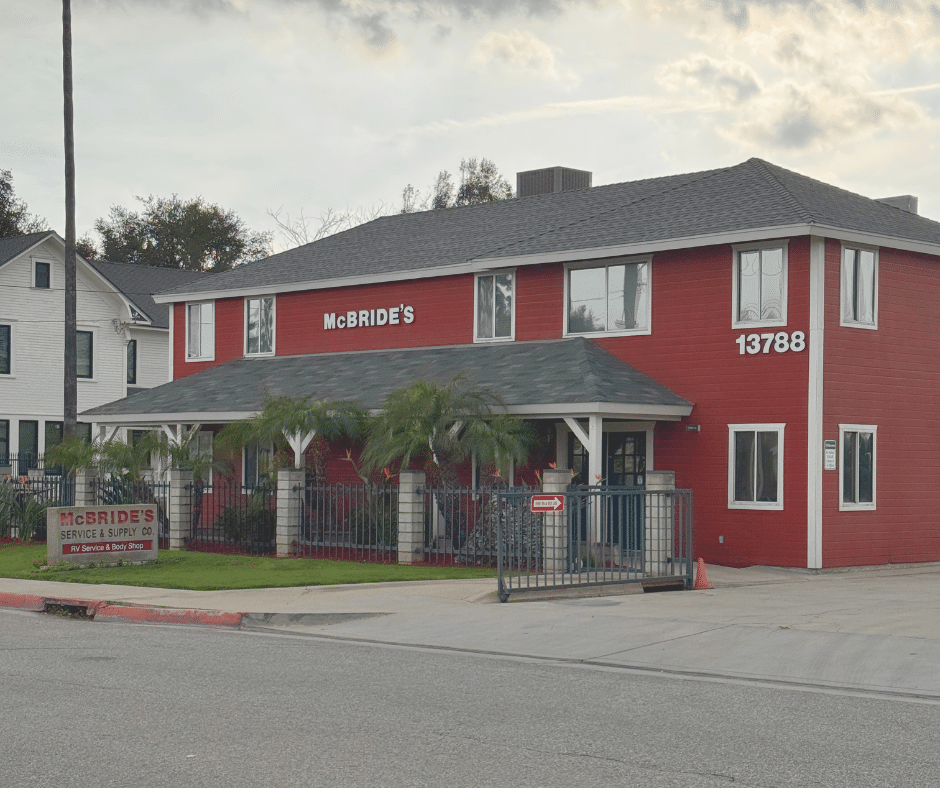
If an appliance in your coach has stopped working, the useful next step is a diagnosis rather than a parts order. Bring it to Chino and we will find out what actually failed and tell you whether it is worth fixing. McBride's RV has been family-owned here since 1967, we service the house systems, the chassis and the body under one roof, and we show you the problem before any work begins. Walk-ins welcome. Call (909) 627-7566 and we will book you in.
McBride's RV Service & Paint, BAR ARD 314817, 13788 Oaks Ave, Chino, CA 91710, (909) 627-7566.